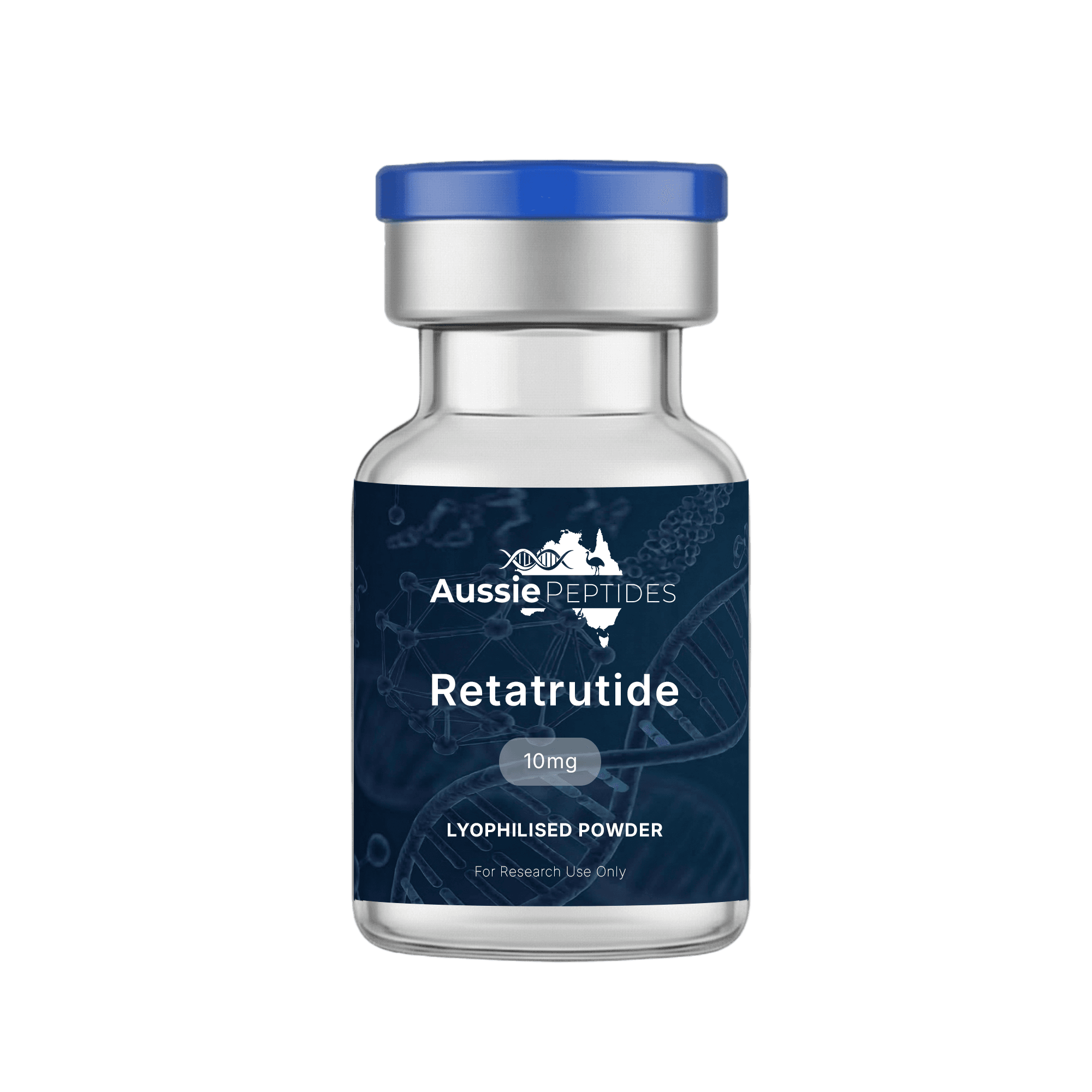
If you've been following the world of metabolic health, you've probably heard the names semaglutide, tirzepatide, and now retatrutide thrown around like they're all the same thing. They're not. Each generation of these compounds targets a different combination of hormone receptors, and that single distinction changes everything about how the body responds.
The Receptor Tier System
To understand why these compounds behave differently, you need to understand what they're actually targeting. Three hormone receptors sit at the centre of this story: GLP-1 (glucagon-like peptide-1), GIP (glucose-dependent insulinotropic polypeptide), and glucagon. Each one does something distinct.
- GLP-1 slows gastric emptying, reduces appetite by acting on the brain's satiety centres, and triggers insulin secretion in a glucose-dependent way — meaning it does not cause hypoglycaemia the way older diabetes drugs do. [1]
- GIP enhances insulin secretion and acts directly on subcutaneous white adipose tissue, increasing insulin-dependent translocation of the GLUT4 glucose transporter to the plasma membrane — effectively presensitising fat cells to insulin rather than acting as an insulin mimic. [2]
- Glucagon raises blood glucose on its own, but when co-activated alongside GLP-1, the hyperglycaemic effect is substantially blunted while its thermogenic and lipolytic effects remain fully active. Research confirms that glucagon receptor (GCGR) activation boosts energy expenditure across multiple species, including adult humans, and augments the magnitude of weight loss achieved by both selective GLP-1R and dual GIP/GLP-1R agonism in obese animals. [3]
Activating all three together does not simply add their effects — it creates a synergistic metabolic shift that single or dual agonists cannot replicate. [4]
Semaglutide: The Original
Semaglutide (Ozempic/Wegovy) is a GLP-1-only agonist. It was genuinely revolutionary when it launched: in the landmark SELECT cardiovascular outcomes trial involving 17,604 adults with pre-existing cardiovascular disease and obesity but without diabetes, semaglutide demonstrated a 20% reduction in major adverse cardiovascular events. [5] [6] By today's standards, however, it is the baseline, not the ceiling. Its mechanism is potent but narrow — appetite suppression, slower digestion, and glucose regulation — without meaningfully increasing energy expenditure through thermogenesis the way newer compounds do. [7]
Tirzepatide: The Dual Upgrade
Tirzepatide (Mounjaro/Zepbound) added the GIP receptor to the equation, making it the first approved dual GLP-1/GIP agonist. The GIP component meaningfully improves insulin sensitivity in adipose tissue and enhances the appetite-suppressing effects of GLP-1. This is why tirzepatide consistently outperforms semaglutide in head-to-head comparisons: in the SURMOUNT-5 trial, average weight loss in the tirzepatide group was 20.2% compared with 13.7% for semaglutide at 72 weeks, with tirzepatide superior across all key secondary endpoints. [8] [9] A 2025 meta-analysis of 36,754 tirzepatide participants confirmed a weighted mean difference of 4.23% greater weight loss compared to semaglutide across all trial durations. [10]
Retatrutide: The Triple Agonist
Retatrutide (LY3437943) is the next evolution — a GLP-1/GIP/glucagon triple agonist. Adding the glucagon receptor is the key differentiator. Research confirms that GCGR activation, when coupled with GLP-1R agonism, increases energy expenditure in obese humans, stimulates brown adipose tissue (BAT) thermogenesis, and drives a right-shift in the weight loss curve beyond what dual agonism achieves alone. [11] [3]
The clinical data reflects this. In Phase 2 trials, the 12 mg dose of retatrutide produced a mean body weight reduction of more than 24% after 48 weeks, with 100% of participants taking the 8 mg and 12 mg doses achieving at least 5% weight loss. Crucially, no plateau was observed at 48 weeks, suggesting results would continue beyond the trial period. [12] [13] In Phase 3 (the TRIUMPH-4 trial, with topline results announced December 2025), participants taking the 12 mg dose achieved an average weight loss of 28.7% (an average of 71.2 lbs / 32.3 kg) at 68 weeks — the highest weight loss ever recorded in a Phase 3 obesity trial — with significant improvements in knee osteoarthritis pain as a secondary endpoint. [14] [15]
Side-by-Side: The Key Differences
Why the Glucagon Addition Changes the Game
The glucagon receptor is the component that separates retatrutide from everything before it. Pre-clinical and early clinical evidence confirms that GCGR activation increases whole-body metabolic rate through BAT thermogenesis, stimulates lipolysis, and augments weight loss beyond what GLP-1 or GLP-1/GIP agonism achieves alone — not simply by further reducing appetite, but by increasing the rate at which energy is burned. [16] [11] [3]
It is also worth noting that a new safety signal — dysaesthesia (an abnormal sense of touch) — emerged in the TRIUMPH-4 Phase 3 data that was not prominently observed in Phase 2. This will be an important variable to follow as further Phase 3 trial readouts are published in 2026. [17]
The practical distinction: semaglutide tells your brain to eat less. Tirzepatide tells your brain to eat less and improves how your fat tissue handles insulin. Retatrutide does all of that, plus increases how much energy your body burns at rest.
References
- Nature – GLP-1 Receptor: Mechanisms and Advances in Therapy (2024)
- Mohammad et al. – Gastric Inhibitory Peptide Controls Adipose Insulin Sensitivity, PMC (2011)
- PMC – Is Glucagon Receptor Activation the Thermogenic Solution for Obesity? (2022)
- PMC – Glucagon, GLP-1 and Thermogenesis (2019)
- ACC.org – SELECT Trial: Semaglutide Effects on Cardiovascular Outcomes (2023)
- Lincoff et al. – Semaglutide and Cardiovascular Outcomes in Obesity without Diabetes, NEJM (2023)
- Ryan et al. – Long-Term Weight Loss Effects of Semaglutide in Obesity, Nature Medicine (2024)
- Rheumatology Advisor – Tirzepatide Bests Semaglutide in SURMOUNT-5 Trial (2024)
- ACC.org – SURMOUNT-5: Greater Loss of Weight with Tirzepatide (2025)
- PMC – Comparative Efficacy of Tirzepatide vs. Semaglutide, Meta-analysis (2025)
- PMC – Glucagon Receptor Agonism and Brown Adipose Tissue Thermogenesis
- Jastreboff et al. – Triple-Hormone-Receptor Agonist Retatrutide for Obesity, NEJM (2023)
- Falk Foundation – Triple-Hormone-Receptor Agonist Retatrutide – Phase 2 Trial (2023)
- Eli Lilly / PR Newswire – TRIUMPH-4 Phase 3 Topline Results (December 2025)
- Clinical Trials Arena – Lilly's Retatrutide: 28.7% Weight Loss in Phase 3 (2025)
- Diabetes Journals – Energetic Contributions of GLP-1 and GCGR Activity in Triagonism (2023)
- BioSpace – Retatrutide TRIUMPH-4 Safety Signal: Dysaesthesia (2025)
⚠ All information is for educational and research purposes only. Retatrutide is not currently approved by the TGA or FDA for human use. For in-vitro research and laboratory use only. Not for human consumption.